Our student Diego Soto Martín has presented his MSc thesis "SwarmCity: control y monitorización de ciudades con enjambres aéreos" ("SwarmCity: control and monitoring of cities with aerial swarms").
During this academic year, he has worked to provide functionalities to the swarm. Specifically, he has developed a behavior-based architecture using IB2C library that allows the drones to perform multiple tasks. Among these tasks, we can find go to points, avoid obstacles, detect and follow cars and people, search the gradients of temperature and pollution, and fly in formation. Some videos are shown below...
Our student Javier Real Valdés has presented his BSc thesis "Tratamiento y visualización de datos urbanos obtenidos por un enjambre de drones" ("Treatment and visualization of urban data obtained by a drone swarm").
This work was focused on the treatment of the urban data provided by the aerial swarm, such as measurements of temperature or contaminant gases and detections of cars or pedestrians. This treatment aims to remove the redundant data and discover the relevant information. For this purpose, it applies Gaussian processes and neural networks.
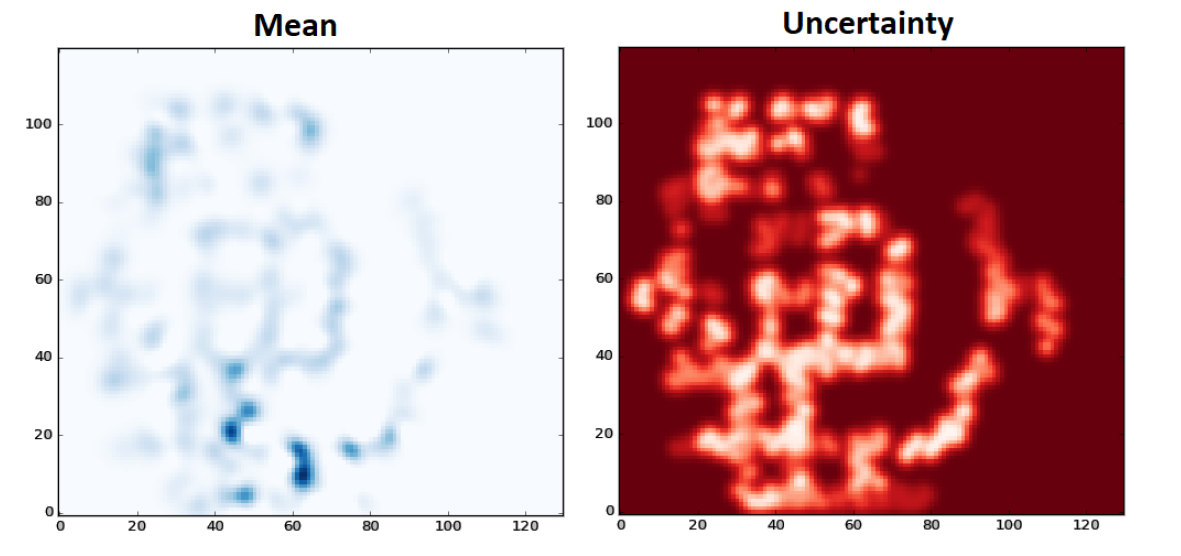
Gaussian processes are used to fuse the data provided by drones and obtain information referenced spatially and temporally. The spatial resolution and temporal window must be tuned to the specific variables to obtain valuable information. For instance, the spatial and temporal variabilities are wider for cars and pedestrians than for climate and pollution.
Convolutional neural networks are applied to analyze the generated maps and determine the points of interest. These neural networks are trained with a set of maps manually tagged by an operator. Therefore, these evaluations have not only an objective part (e.g. the points with higher traffic are remarked), but also a subjective part (e.g. the operator choice between multiple traffic jams).
Finally, an immersive interface was developed to visualize the information of the city. This interface takes advantage of virtual reality to reproduce the city and overlap the maps of temperature, pollution, traffic and pedestrians. The resulting interface was comfortable and intuitive as shown by the following video.
We are preparing a scientific paper with the full details of this work!
SwarmCity Project has started with a first meeting at the Centre for Automation and Robotics (UPM-CSIC). The 11 members of the team (1 professor, 2 PhD students, 2 MSc students and 6 BSc students) have met for the first time. In this meeting, we have presented the project and discussed its work packages. In the following ones, we are going to teach students on multi-agent systems, behavior-based architectures and machine learning.
Seven students will develop their MSc and BSc under SwarmCity Project. Some of them will develop components related to the city, swarm and interface, whereas other ones will work in other relevant environments such as the Robocup.
SwarmCity: control and monitoring of cities with aerial swarms (MSc thesis)
SwarmCity: Applying game theory to the management of drone swarms (BSc thesis)
SwarmCity: visual recognition of targets in the city (BSc thesis)
Treatment and visualization of urban data obtained by a drone swarm (BSc thesis)
Attack and defense techniques with swarms of heterogeneous drones (BSc thesis)
Algorithms for resource collection through ground robot swarms (BSc thesis)
Creation of strategies for robotic football teams (BSc thesis)
Future cities will be bigger and their management more complex, posing challenges related to the traffic, management of resources, maintenance of green zones, pollution, etc. The aim of this project is to provide a tool to collect the relevant information of these cities to allow their authorities to make correct and efficient decisions. The proposal goes further than the current solutions based on fixed sensors, making use of an aerial robot swarm to obtain information at desired locations and times. The work is focused on the development of swarming algorithms to solve complex tasks through the combination of simple individual behaviors, as well as data mining techniques and immersive interfaces for processing and visualizing the information. Moreover, the scenario will be used as a testbed for new algorithms designed to create an emergent and distributed intelligence that will learn from the environment.
In other words, SwarmCity is the sum of a smart city, a robot swarm and a control interface:
The smart city has been developed by using Unity game engine. It is a simulator of a scaled city that includes traffic, pedestrians, garbage, climate and pollution. It is used not only as a view tool but also as a data source.
The robot swarm has to cover the city collecting data about the traffic jams, people crowds, contaminant emissions... For this purpose, we are going to study behavior-based architectures, multiple techniques of optimization, game theoretical decision making...
The control interface must allow the operators to monitorize the state of the city, as well as to configure the swarm. For this purpose, we are going to explore data mining techniques to discover information, machine learning algorithms to adapt it to operator and immersive technologies to show it in a easy to understand way.